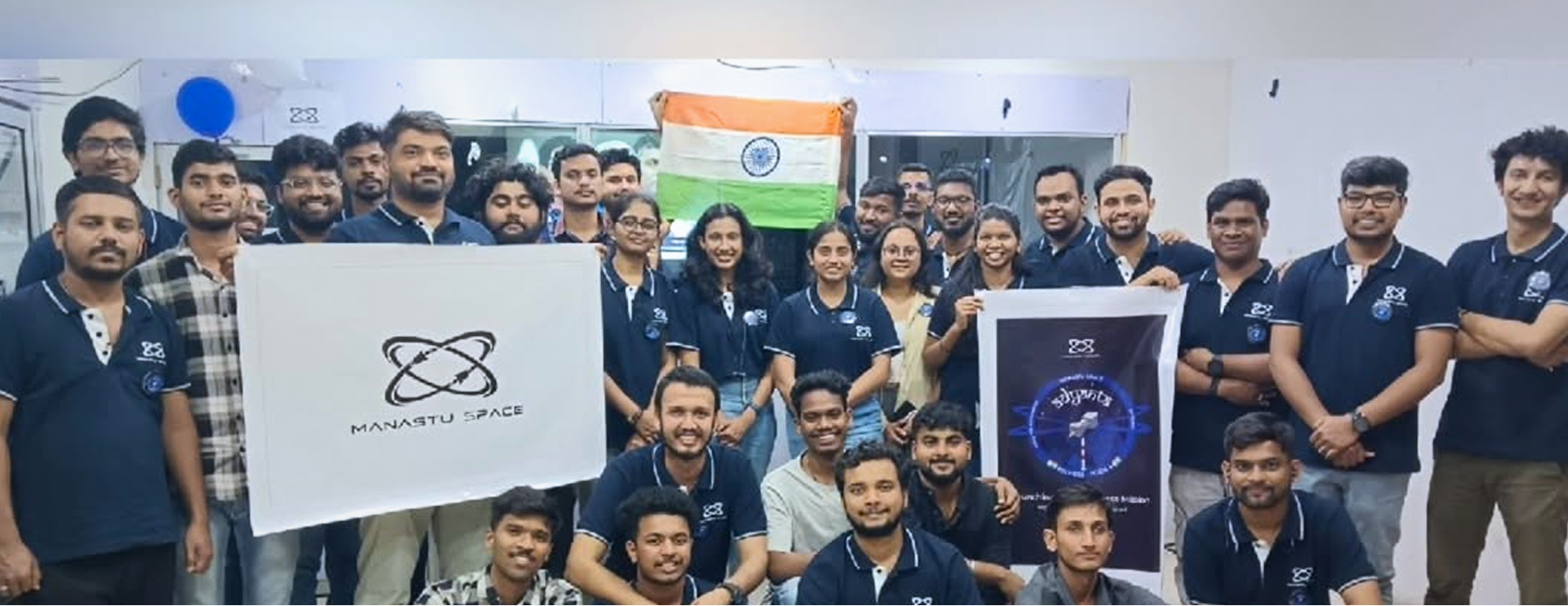
Culture is how we fly
Making way for the next dreamer to come and join the band wagon.

Our Values

"Alone we can do so little, together we can do so much."








Open Roles
Explore opportunities and build a promising career in Space-Tech Innovation
Role Objective
Own the sensing, data acquisition, valve actuation and measurement backbone of the propulsion test facility end to end and build and lead the instrumentation team that runs it. The goal is a facility where every new rig is instrumented against a frozen requirement, every channel produces clean, calibrated and traceable data on every firing, test campaigns run round the clock without instrumentation delays, and the facility keeps pace with Manastu's growth through clear standards and a costed upgrade roadmap.
Role Overview
Every firing, every pressure spike, every millisecond of thermal data that proves our thrusters work starts with the instrumentation. As the Lead Instrumentation Engineer in Propulsion Testing, you'll head our instrumentation team and own the sensing, data acquisition, actuation and measurement backbone of our propulsion test facility, building it up alongside the AIT team and standing at the console when the thrusters fire.
This is a hands-on, high-ownership role at the heart of our test operations. You'll work shoulder-to-shoulder with space veterans who've spent careers building and firing propulsion systems, a rare chance to learn flight-grade test discipline directly from the people who wrote the playbook. Test windows don't always fall in business hours: hot-fire and qualification campaigns often run late, and you'll be there through them, making sure every channel captures clean, reliable data when it counts.
Key Responsibilities
● Team leadership: Lead and build the instrumentation team, setting technical direction, mentoring engineers and technicians, allocating work across test campaigns, and growing the group as the facility scales.
● Shift cover: Organise round-the-clock (24-hour) test cover with a working shift roster, and train technicians to run set-ups unsupervised.
● Requirement analysis: Translate test objectives into a frozen instrumentation requirement for every new rig (measurement list, ranges, accuracy, sample rates, channel count and layout) before the rig is built.
● Facility integration: Coordinate closely with the AIT team and ex-ISRO propulsion experts to establish and integrate the test facility, defining instrumentation layouts, wiring diagrams and channel lists for hot-fire, cold-flow and qualification campaigns.
● DAQ architecture: Design, build and commission the instrumentation and data acquisition (DAQ) architecture for the propulsion test facility, from sensor selection through signal path to recorded data.
● Sensors and calibration: Select, install and calibrate sensors including pressure transducers, thermocouples, load cells, flow meters, strain gauges and accelerometers for propulsion and structural test articles.
● Valve actuation: Own the design of valve actuation for test rigs (currently handled by the avionics department): valve driver circuits, position and feedback sensing, and measurement and verification of actuation timing and valve state.
● Automation and control: Own the automation layer for valves and actuators: specify sequences, interlocks and safe-state behaviour, and evaluate PLC, SCADA and NI-based platforms rather than defaulting to NI alone.
● DAQ / LabVIEW software: Write the requirements and algorithms for DAQ and control software, direct the LabVIEW engineer through the build, and accept the software against a written acceptance test.
● Cabling and grounding: Design and implement power and signal cable layouts and instrument grounding schemes that control noise without compromising measurement accuracy, and issue them as facility standards.
● Signal conditioning and troubleshooting: Configure signal conditioning, verify calibration, and troubleshoot sensors, wiring, signal paths and control loops, often under live test conditions.
● Live test operations: Set up, operate and monitor instrumentation during live propulsion test campaigns, including night and off-hours shifts, and own abort criteria and test holds for instrumentation reasons.
● Facility upkeep: Operate and maintain the test facility and its equipment (power supplies, test and measuring instruments, and automation/feedback-based systems), keeping everything calibrated, safe and campaign-ready.
● Quick set-ups: Stand up quick instrumentation set-ups to meet urgent development-test requirements without cutting corners on safety or data quality.
● Safety and standards: Ensure every test configuration meets safety standards, which is critical when working with high-test peroxide propellants and high-pressure systems, and work to ECSS-aligned and AS9100 practices.
● Documentation and traceability: Own instrumentation documentation (control narratives, functional specs, channel lists, calibration records and post-test data validation reports) to a standard that holds up in an anomaly investigation or an AS9100 audit. Maintain a live baseline of active channels, calibration due dates, noise floors and spares.
● Procurement and spares: Generate equipment and instrument specifications based on test needs, drive procurement, and maintain essential spares through lean inventory management.
● Roadmap: Forecast future facility requirements, publish a costed upgrade roadmap, and adopt emerging technology to keep our test capability current and competitive.
Experience & Background
● BE / B.Tech / M.Tech in Instrumentation, Electronics or Electrical Engineering.
Experience and expertise
● 3–5 years of industrial experience in the above disciplines, handling a range of power supplies, testing instruments and measuring instruments; calibration of instruments; and automation involving feedback-based operations.
● Operation and maintenance of test facilities built around the above equipment and instruments.
● Setting up instrumentation facilities to industry standards and safety/environmental protocols, including writing measurement requirements and selecting the right range and accuracy of instruments for the test conditions.
● Specialisation in power and signal cable layout design and implementation, and in instrument grounding to control noise levels without affecting measurement accuracy during data acquisition.
● Hands-on configuration of NI DAQ hardware and LabVIEW-based systems; exposure to PLC and SCADA control platforms.
● Design of valve driver / actuation circuits and position or feedback sensing, including verifying actuation timing.
● Developing system-operation and facility-maintenance documentation, with calibration traceability.
● Ability to develop quick instrumentation test set-ups to meet urgent development-test requirements.
● Organising teams to meet round-the-clock (24-hour) testing requirements as and when required.
● Generating equipment / instrument specifications based on needs, driving procurement, and maintaining essential spares through lean inventory management.
● Forecasting future requirements and adopting changing technology to keep facilities up to date.
● Excellent communication skills, including concept presentation and demonstration, and guiding technicians to deliver seamless service.
Bonus points for
● Experience instrumenting propulsion, engine or structural test rigs; harness fabrication and EMI/EMC awareness; exposure to aerospace quality standards (AS9100, ECSS); or hands-on time supporting hot-fire or qualification test campaigns.
Ideal Candidate Profile
● Has written channel lists and chosen ranges personally, not just been handed them, and can state the range, accuracy and uncertainty of every instrument they have used.
● Has selected parts and drawn circuits themselves and can explain the trade-off behind each choice rather than naming a catalogue part.
● Backs grounding and shielding decisions with before/after noise numbers and a grounding scheme they drew.
● Has configured DAQ and control software personally, written specs and acceptance tests, and can argue for a control platform choice (NI, PLC or SCADA).
● Has sat the console on live firings and has called a hold when data quality or safety demanded it.
● Writes requirements instead of waiting for them and can get a design or spec changed when the rig cannot support the measurement.
● Builds people: has trained technicians to run set-ups unsupervised and has organised cover for 24-hour test windows.
● Raises problems early, even when it costs schedule, never signs off data they are not sure of, and leaves drawings and records behind.
What we offer
- Build and lead the instrumentation team from the ground up and shape how testing is done at Manastu
- Competitive compensation
- Comprehensive health insurance
- High ownership and visibility, with direct access to leadership
- Support for learning, conferences, and research exposure
- Subsidized lunch plan
If you are motivated by solving complex challenges at scale, we would like to hear from you (careers@manastuspace.com)
Manastu Space is a pioneering space technology company developing green propulsion systems, redefining space safety. We specialize in full-stack maneuverability solutions for satellites and upper stages of launch vehicles. As the number of satellites in orbit continues to grow, ensuring safe and reliable maneuverability has become critical for mission-success and long-term orbital sustainability.
Our propulsion systems offer an agile and enhanced maneuvering, with its proprietary hydrogen peroxide-alcohol based novel green propellant; MS-289. This performance-enhancing and high reliability fuel replaces toxic propellants such as hydrazine, making it the future-ready choice for sustainable satellite propulsion.
Designed for safety, rapid integration and operational efficiency, our systems provide the precision required for orbit-raising, station-keeping, collision avoidance and end-of-life deorbiting, helping operators safeguard assets while reducing the growing threat of space debris.
Website: https://www.manastuspace.com
LinkedIn: https://www.linkedin.com/company/manastu-space/
Email: careers@manastuspace.com
Role Objective
Lead the design, analysis and qualification of the metallic propellant tanks for our hydrogen peroxide–based green monopropellant propulsion systems — from requirements to flight-qualified hardware.
The role owns tank development end to end: deriving requirements and design trades; designing to pressure-vessel codes with static, fatigue and dynamic analysis; designing for manufacture and welding; helping establish the weld procedures; qualifying the design to code; and ensuring conformance through manufacture — setting the pressure-vessel standards the company builds to.
Role Overview
We are seeking an experienced Pressure Vessel Development Lead to join our growing aerospace facility in Navi Mumbai, with strong expertise in metallic pressure-vessel design, analysis and qualification.
Manastu's propellant tanks are moving from development to flight-qualified production, and this is a foundational role: you will set the pressure-vessel standards and practices the company builds to, take tanks through qualification to launch-provider standards, and build the tank team. As its founding member, you will work hands-on across requirements, design, analysis and test.
You will work closely with propulsion, materials and processes, structures and thermal engineers — helping establish the weld procedures (WPS/PQR) for each weld configuration with Materials & Processes, and analysing the tank against the launch environments you are given. The role focuses on metallic propellant tanks.
Key Responsibilities
Derive tank requirements — volume, maximum expected operating pressure (MEOP, including decomposition-driven pressure rise), cycle life and leak rate — and run the design trades, choosing the alloy from the approved material list against those requirements.
Design metallic propellant tanks to AIAA S-080/081 and ASME BPVC Section VIII; own proof, burst and safety factors and the tank safety case.
Substantiate life — safe-life and leak-before-burst arguments, fatigue and crack-growth analysis.
Design for manufacture and welding (DFM/DFW) — machined domes, bosses and tolerances; weld joint type, process (friction stir or fusion), location and a weld land sized for the heat-affected zone — and help establish the WPS/PQR for each weld configuration with Materials & Processes and the vendor; design O-ring glands to AS568; allocate the leak rate and verify it by helium leak testing.
Design the tank around its diaphragm propellant management device (PMD) — expulsion efficiency, residuals, and slosh forces for attitude control.
Develop qualification and acceptance test plans to the pressure code, with test levels and pass/fail criteria derived from the requirements and the code; witness proof, burst, pressure cycling, leak, vibration and thermal-vacuum testing, freezing every design parameter — weld joints included — through qualification to code.
Ensure conformance through manufacture — in-process and first-article inspection, unit acceptance, nonconformance reports (NCRs) raised and closed through the material review board (MRB), and supplier evidence reviewed rigorously.
Own the tank interface control documents (ICDs) with the feed system, structures and thermal, and report mass and centre of gravity against the system budget.
Run the analysis yourself — static analysis to burst, dynamic analysis (modal, random vibration and shock) against the launch vehicle environment, fatigue and crack growth — with CAD and drawings to ASME Y14.5.
Design safety into every pressure test and procedure, with test hazards registered before testing begins.
Build and lead the tank team, and release design rules, weld specifications and the leak-rate specification as company standards.
Experience & Background
Degree in mechanical, aerospace, structural or materials engineering, with 6–12 years in aerospace pressure-vessel or propellant-tank design. A Master's in structures, fracture mechanics or pressure-vessel design is an advantage.
Designed at least one metallic pressure vessel to AIAA S-080/081, ASME BPVC Section VIII or ECSS-E-ST-32, from requirements through proof and burst testing.
Hands-on, not delegated: CAD (SolidWorks/CATIA) with GD&T to ASME Y14.5; static and dynamic FEA (Ansys/Abaqus) — non-linear to burst, modal and random vibration; fatigue and crack-growth analysis (NASGRO/AFGROW or equivalent); a safe-life or leak-before-burst substantiation authored or reviewed.
Design for manufacture and welding (DFM/DFW) and sealing — joint type and location, helping establish WPS/PQR with vendors, O-ring glands to AS568, leak-rate specification and helium leak testing.
Developed and witnessed a qualification or acceptance test campaign to a pressure code (AIAA S-080/081 or ASME BPVC Section VIII), with pass/fail criteria derived from requirements, and ensured conformance through NCR and MRB.
Led, mentored or built a team of engineers.
Ideally: flight propulsion hardware, especially diaphragm or PMD tanks; friction stir welding of aluminium; slosh analysis; launch-provider safety reviews; green propellant or hydrogen peroxide systems.
Ideal Candidate Profile
A hands-on pressure-vessel engineer who takes a vessel from code design and analysis through manufacture and qualification, runs their own analysis, works with welders and vendors, and backs every claim with a number.
Challenges designs — their own included — stops a test when it isn't safe, and reports bad news early.
Owns interfaces, influences across teams without formal authority, and builds a team that carries the work forward.
What we offer
- Competitive compensation
- Comprehensive health insurance
- High ownership and visibility, with direct access to leadership
- Support for learning, conferences, and research exposure
- Subsidized lunch plan
If you are motivated by solving complex challenges at scale, we would like to hear from you (careers@manastuspace.com).
Manastu Space is a pioneering space technology company developing green propulsion systems, redefining space safety. We specialize in full-stack maneuverability solutions for satellites and upper stages of launch vehicles. As the number of satellites in orbit continues to grow, ensuring safe and reliable maneuverability has become critical for mission-success and long-term orbital sustainability.
Our propulsion systems offer an agile and enhanced maneuvering, with its proprietary hydrogen peroxide-alcohol based novel green propellant; MS-289. This performance-enhancing and high reliability fuel replaces toxic propellants such as hydrazine, making it the future-ready choice for sustainable satellite propulsion.
Designed for safety, rapid integration and operational efficiency, our systems provide the precision required for orbit-raising, station-keeping, collision avoidance and end-of-life deorbiting, helping operators safeguard assets while reducing the growing threat of space debris.
Website: https://www.manastuspace.com
LinkedIn: https://www.linkedin.com/company/manastu-space/
Email: careers@manastuspace.com
Role Objective
This role builds Manastu's surface treatment capability for green propulsion, from the laboratory bench to flight. You will decide how we clean, treat and verify every propellant-wetted surface. Your results will set how long our hydrogen peroxide-based green monopropellant stays stable in flight hardware.
You will own the work end to end: the research roadmap, the targets, the team, the vendors and the specification that production uses. Our own measured data, not vendor claims, will support each decision.
Role Overview
We need a Research Scientist in Navi Mumbai with a PhD and 5 to 10 years of post-PhD industry experience. This is a senior, hands-on role.
The central technical challenge is surface-driven decomposition. Hydrogen peroxide decomposes faster when it touches a surface, and the rate changes with the material, its surface condition and trace metal contamination. Stainless steel, aluminium alloys, welds, polymers and seals must each stay compatible with the propellant for the full mission life. Test methods that customers and agencies accept must show this result.
You will work at the intersection of electrochemistry, surface science, process engineering and propulsion. The design, propellant, manufacturing, quality and test teams will use your results to make engineering decisions.
Key Responsibilities
Rank the root causes of decomposition in our data, and build the research roadmap with pass or fail criteria.
Define the people, equipment, budget, vendors and treatment route that the roadmap needs, and present them for founder approval.
Set measurable decomposition targets for each alloy family, meet them on schedule, and report progress to the founders.
Establish the cleaning, pickling and passivation route for every alloy family, with bath controls and cleanliness limits.
Release the surface treatment specification, and keep it valid when the hardware or the vendors change.
Take each treatment from coupons to welded assemblies and flight-representative hardware, and close any gap between the results.
Qualify the production route at an approved vendor or in house, and add a second source to the same specification.
Deliver the storage life case, with its margin, and the data pack, and defend both in customer and agency reviews.
Run the process under statistical control, close every non-conformance by root cause, and hold cost and lead time to plan.
Build and lead the team, and train it to run the process and acceptance tests without you.
Experience & Background
A PhD in Metallurgical Engineering, Materials Science and Engineering, Corrosion Engineering, Electrochemistry, Surface Engineering, Chemical Engineering or a related discipline.
Between 5 and 10 years of post-PhD industry experience in surface treatment, passivation or corrosion science.
Several surface treatment or passivation processes that you developed and documented yourself, for different alloys or geometries; at least one runs in production today.
A strong foundation in passive film electrochemistry: potential-pH diagrams, mixed potential theory, pitting and transpassive behavior.
Hands-on experience with XPS, EIS, SEM with EDS, potentiodynamic polarisation and profilometry, their artefacts, and cross-checks between them.
A record of processes taken from bench result to qualified production, as the lead for the team, vendors and budget.
Experience of a Nadcap chemical processing or AS9100 audit, and knowledge of standards such as ASTM A380, ASTM A967, AMS 2700 and ASTM B912.
Relevant backgrounds include semiconductor wet processing, pharmaceutical stainless steel water systems, oil and gas corrosion, nuclear, electroplating and anodising, and aerospace chemical processing. Experience in oxidiser service, such as oxygen cleaning to ASTM G93 or hydrogen peroxide, is an advantage, but it is not necessary.
Ideal Candidate Profile
A senior scientist who turns a broad objective into an approved plan, and is accountable for what the team delivers.
Builds methods and test rigs where none exist, does the critical experiments personally, and needs no senior above them in the subject.
Reports data with its uncertainty, says clearly what the data does not show, and changes position only on evidence.
Designs safety into each process, stops a run when something looks wrong, and reports problems early.
What we offer
- Competitive compensation
- Comprehensive health insurance
- High ownership and visibility, with direct access to leadership
- Support for learning, conferences, and research exposure
- Subsidised lunch plan
If you are motivated by solving complex challenges at scale, we would like to hear from you (careers@manastuspace.com).
Manastu Space is a pioneering space technology company developing green propulsion systems, redefining space safety. We specialize in full-stack maneuverability solutions for satellites and upper stages of launch vehicles. As the number of satellites in orbit continues to grow, ensuring safe and reliable maneuverability has become critical for mission-success and long-term orbital sustainability.
Our propulsion systems offer an agile and enhanced maneuvering, with its proprietary hydrogen peroxide-alcohol based novel green propellant; MS-289. This performance-enhancing and high reliability fuel replaces toxic propellants such as hydrazine, making it the future-ready choice for sustainable satellite propulsion.
Designed for safety, rapid integration and operational efficiency, our systems provide the precision required for orbit-raising, station-keeping, collision avoidance and end-of-life deorbiting, helping operators safeguard assets while reducing the growing threat of space debris.
Website: https://www.manastuspace.com
LinkedIn: https://www.linkedin.com/company/manastu-space/
Email: careers@manastuspace.com
Role Objective
Lead the scientific research that makes our hydrogen peroxide-based green propellant safe to store inside flight hardware for the full mission life, fulfilling customer and space agency requirements.
The role is responsible for developing a deep understanding of propellant formulation, degradation, and storability chemistry; controlling propellant life through rational stabilization and interface material selection; and translating this understanding into storage-life predictions and the qualification data required for flight-ready propulsion systems.
Role Overview
We are seeking a Propellant Research Scientist to join our team in Navi Mumbai.
This is a high-ownership research position at the core of our propulsion program, addressing fundamental questions of decomposition kinetics, catalysis by trace impurities, and propellant-material interactions. The answers must hold in flight hardware, where the propellant must remain within specification for the full mission life.
You will work at the intersection of chemistry, materials science, and propulsion hardware, contributing to the development of stable, reliable, and flight-ready peroxide-based propulsion systems.
Key Responsibilities
1. Lead propellant formulation development: design and optimise formulation chemistry for performance, storability, and safety, and establish the stability and hazard classification of each formulation through appropriate characterization and testing.
2. Lead research on propellant storability chemistry, applying reaction kinetics, thermodynamics, free radical chemistry, and oxidizer chemistry to elucidate decomposition pathways driven by trace impurities, metal ions, and container surfaces. Develop stabilization strategies that suppress these pathways, selecting additives by their mechanism of action at the molecular level.
3. Design and execute experimental programs to quantify propellant degradation under mission-relevant conditions of temperature, material interfaces, and trace contamination, and develop accelerated-ageing methods and predictive models that translate laboratory kinetics into validated storage-life predictions for flight hardware.
4. Select and qualify wetted materials for the propulsion system: evaluate propellant-material molecular interactions at the interface, measure decomposition and attack rates per material, define compatibility limits, and verify surface passivation by test.
5. Translate research findings into engineering practice: propellant specifications with acceptance limits, storage and handling guidelines, and design rules for propulsion system hardware.
6. Lead failure investigations and anomaly resolution related to propellant stability, material compatibility, or unexpected decomposition behaviour, establishing each mechanism with analytical evidence and driving it to root cause and verified resolution.
7. Generate the qualification data and technical justification required for propulsion system storage certification and flight readiness reviews.
8. Publish technical findings internally and externally, mentor team members, and build laboratory capability, with safety integrated into every experimental plan from the outset.
Experience & Background
- PhD in Chemistry (Organic or Polymer) or a related field.
- Minimum 5 years of post-PhD industry or equivalent experience, ideally in formulation chemistry across fields such as propellants, pharmaceuticals, specialty chemicals, etc., where formulation chemistry governs stability and product performance.
- Strong command of analytical and characterization techniques, with the data analysis and interpretation skills to develop property-stability correlations.
- A strong publication record (patents, research papers, and conferences), ideally with a formulation taken from the laboratory to a released product or specification.
- Ability to work in a timeline-driven, result-oriented, and fast-paced environment with a safety-first approach.
Ideal Candidate Profile
A hands-on experimental scientist with strong expertise in formulation development and stability studies, able to defend mechanisms and shelf-life claims with measured data.
Combines molecular-level understanding with system-level thinking, translating hardware requirements into chemistry and research findings into engineering practice, with demonstrated experience in failure analysis and complex stability problems.
Works independently, communicates effectively across engineering teams and leadership, and treats safety as an integral part of the science.
What we offer
- Competitive compensation
- Comprehensive health insurance
- High ownership and visibility, with direct access to leadership
- Support for learning, conferences, and research exposure
- Subsidized lunch plan
If you are motivated by solving complex challenges at scale, we would like to hear from you (careers@manastuspace.com).
Manastu Space is a pioneering space technology company developing green propulsion systems, redefining space safety. We specialize in full-stack maneuverability solutions for satellites and upper stages of launch vehicles. As the number of satellites in orbit continues to grow, ensuring safe and reliable maneuverability has become critical for mission-success and long-term orbital sustainability.
Our propulsion systems offer an agile and enhanced maneuvering, with its proprietary hydrogen peroxide-alcohol based novel green propellant; MS-289. This performance-enhancing and high reliability fuel replaces toxic propellants such as hydrazine, making it the future-ready choice for sustainable satellite propulsion.
Designed for safety, rapid integration and operational efficiency, our systems provide the precision required for orbit-raising, station-keeping, collision avoidance and end-of-life deorbiting, helping operators safeguard assets while reducing the growing threat of space debris.
Website: https://www.manastuspace.com
LinkedIn: https://www.linkedin.com/company/manastu-space/
Email: careers@manastuspace.com
Role Objective
This role builds Manastu's elastomer capability for green propulsion, from the laboratory bench to flight. You will decide which elastomers seal and separate our propellant, and which vendors supply them. Your results will set how long our hydrogen peroxide-based green monopropellant stays stable in flight hardware.
You will own the work end to end: the research roadmap, the targets, the team, the vendors and the materials specification that production uses. Our own measured data, not vendor data sheets, will support each decision.
Role Overview
We need a Polymer Research Scientist in Navi Mumbai with a PhD and 5 to 10 years of post-PhD industry experience. This is a senior, hands-on role.
The central technical challenge is compatibility in two directions. Hydrogen peroxide can harden, swell or weaken an elastomer. The fillers, cure residues and additives in the elastomer can also make the propellant decompose. The diaphragm must also flex on every expulsion and stay compatible for the full mission life. Test data that customers and agencies accept must support each material choice.
You will work at the intersection of polymer chemistry, materials testing, supplier quality and propulsion. The design, propellant, metallurgy, manufacturing and test teams will use your results to make engineering decisions.
Key Responsibilities
1. Own the research roadmap: rank the root causes of elastomer failure in our data, and set pass or fail criteria.
2. Own the budget, people, equipment and vendor plan, hold cost and lead time to it, and answer to the founders.
3. Set measurable targets for each part, meet them on schedule, and report any miss without delay.
4. Make the formulation and vendor decision for each part on data, and record the reason for every rejection.
5. Set the failure criteria and write the materials specification, and approve every change to both.
6. Take each material from coupons to components and flight-representative hardware, and close any gap between the results.
7. Approve or reject each vendor against our requirements, control incoming lots statistically, and keep a second vendor per part.
8. Sign the storage life case and the data pack, and defend both in customer and agency reviews.
9. Stop any test, lot or delivery that breaks a limit, and close each non-conformance by root cause.
10. Build and lead the team, and train it to run the tests and incoming checks without you.
Experience & Background
1. A PhD in Polymer Science, Polymer Engineering, Materials Science and Engineering, Chemical Engineering, Chemistry or a related discipline.
2. Between 5 and 10 years of post-PhD industry experience with elastomers, seals or polymer compatibility.
3. A strong foundation in polymer degradation chemistry: oxidation, chain scission and post-crosslinking, with rate constants and activation energies.
4. Knowledge of elastomer compounds: base polymer, crosslink density, cure system, fillers and additives, and their effect on compatibility.
5. Several elastomer formulations that you selected and qualified with vendors, for different parts or service conditions; at least one is in production use today.
6. Hands-on experience with volume swell, hardness, compression set, tensile and FTIR tests to ASTM D471, D395, D2240 and D412, and cross-checks between them.
7. A record of materials taken from screening to qualified production as the lead, and experience of a Nadcap elastomer seals or AS9100 audit.
8. Relevant backgrounds include O-ring and seal compounding, semiconductor wet processing, oil and gas, aerospace propulsion, and nuclear or pharmaceutical equipment. Experience in oxidiser service, such as nonmetallic materials for oxygen service to ASTM G63 or hydrogen peroxide, is an advantage, but it is not necessary.
Ideal Candidate Profile
• A senior scientist who turns a broad objective into an approved plan, and is accountable for what the team delivers.
• Builds methods and test rigs where none exist, does the critical tests personally, and needs no senior above them in the subject.
• Explains a materials decision to people who are not polymer scientists, says clearly what they do not know, and changes position only on evidence.
• Makes each test safe and clean by design, and reports problems early.
What we offer
- Competitive compensation
- Comprehensive health insurance
- High ownership and visibility, with direct access to leadership
- Support for learning, conferences, and research exposure
- Subsidised lunch plan
If you are motivated by solving complex challenges at scale, we would like to hear from you (careers@manastuspace.com).
Manastu Space is a pioneering space technology company developing green propulsion systems, redefining space safety. We specialize in full-stack maneuverability solutions for satellites and upper stages of launch vehicles. As the number of satellites in orbit continues to grow, ensuring safe and reliable maneuverability has become critical for mission-success and long-term orbital sustainability.
Our propulsion systems offer an agile and enhanced maneuvering, with its proprietary hydrogen peroxide-alcohol based novel green propellant; MS-289. This performance-enhancing and high reliability fuel replaces toxic propellants such as hydrazine, making it the future-ready choice for sustainable satellite propulsion.
Designed for safety, rapid integration and operational efficiency, our systems provide the precision required for orbit-raising, station-keeping, collision avoidance and end-of-life deorbiting, helping operators safeguard assets while reducing the growing threat of space debris.
Website: https://www.manastuspace.com
LinkedIn: https://www.linkedin.com/company/manastu-space/
Email: careers@manastuspace.com
Role Objective
Lead the scientific research and experimental development of high-temperature-stable catalysts that initiate decomposition and sustain combustion of our hydrogen peroxide–based green monopropellant inside the thrusters — reliably, through repeated starts and long cumulative firing, for the full life of the mission.
The role owns catalyst science end to end: elucidating the catalyst degradation mechanisms at work in the high-temperature, oxidising environment of the thruster, designing catalyst formulations that withstand it, and maturing the laboratory-scale preparation into a standardized, quality-controlled process supported by a qualification data pack accepted by customers and space agencies.
Role Overview
We are seeking an experienced Catalyst Research Scientist to join our growing aerospace facility in Navi Mumbai, with strong expertise in heterogeneous catalysis — rational catalyst design, preparation, and characterization.
The role addresses two central technical challenges: catalyst deactivation under the thermal and oxidizing conditions of thruster operation, and batch-to-batch variation in catalyst properties between preparations of identical chemical composition. Solving them demands a rigorous understanding of structure–activity relationships, combined with disciplined process control and scale-up.
You will work at the intersection of materials chemistry, heterogeneous catalysis, and propulsion hardware, contributing to the development of stable, reliable, and flight-ready catalyst beds for green propulsion systems.
Key Responsibilities
1. Design, synthesize, and shape high-temperature-stable catalysts for the decomposition and combustion of our hydrogen peroxide–based green monopropellant inside the thrusters.
2. Lead the investigation of catalyst degradation mechanisms and catalyst bed failures — chemical, thermal, and mechanical — establishing each mechanism with characterization evidence and driving it to root cause and verified resolution.
3. Plan and execute structured catalyst screening campaigns — supported by lab-scale tests, to predict catalyst functionality inside the thruster — and down-select candidate materials on measured evidence.
4. Establish structure–activity correlations, identifying the intrinsic catalyst properties that govern activity and operational life, and develop validated models to predict catalyst bed performance.
5. Perform and interpret catalyst characterization using techniques such as XRD, XPS, BET, SEM/TEM, ICP, TGA, chemisorption, and mechanical testing.
6. Standardize the catalyst preparation process into SOPs with QA/QC acceptance limits, and scale it up to the batch sizes required for qualification.
7. Compile the qualification data pack — catalyst specifications, quality standards and traceability from raw material to fired bed — required for certification by customers and space agencies.
8. Publish technical findings internally and externally, mentor team members, and build laboratory capability, with safety integrated into every experimental plan from the outset.
Experience & Background
1. PhD in Catalysis, or a related field, with a minimum of 5 years of post-PhD industry or equivalent experience in heterogeneous catalyst development — ideally for high-temperature, oxidizing, or similarly demanding environments.
2. Hands-on experience in catalyst synthesis (impregnation, hydrothermal, co-precipitation, or similar routes) and shaping (granulation, pelletizing, or extrusion), with a sound understanding of how preparation variables govern catalyst properties.
3. Strong grounding in catalyst deactivation mechanisms and failure analysis, supported by hands-on command of characterization techniques such as XRD, XPS, BET, SEM/TEM, ICP, TGA, chemisorption, and mechanical testing.
4. Experience in process standardization and scale-up — SOPs, QA/QC acceptance limits, and quality control across repeated batches.
5. A strong publication record (patents, research papers, and conferences), ideally with a catalyst taken from the laboratory to a released product or specification.
6. Ability to work in a timeline-driven, result-oriented, and fast-paced environment with a safety-first approach.
Ideal Candidate Profile
• A hands-on catalyst scientist experienced in synthesis, shaping, characterized, and scaled catalysts — and supports every claim with measured data.
• Combines a scientist’s understanding of mechanisms and structure–activity relationships with an engineer’s discipline in process control — having taken at least one material from concept to reliable, repeatable batches.
• Works independently, communicates effectively across engineering teams and leadership, and treats safety as an integral part of the science.
What we offer
- Competitive compensation
- Comprehensive health insurance
- High ownership and visibility, with direct access to leadership
- Support for learning, conferences and research exposure
- Subsidized lunch plan
If you are motivated by solving complex challenges at scale, we would like to hear from you (careers@manastuspace.com).
Manastu Space is a pioneering space technology company developing green propulsion systems, redefining space safety. We specialize in full-stack maneuverability solutions for satellites and upper stages of launch vehicles. As the number of satellites in orbit continues to grow, ensuring safe and reliable maneuverability has become critical for mission-success and long-term orbital sustainability.
Our propulsion systems offer an agile and enhanced maneuvering, with its proprietary hydrogen peroxide-alcohol based novel green propellant; MS-289. This performance-enhancing and high reliability fuel replaces toxic propellants such as hydrazine, making it the future-ready choice for sustainable satellite propulsion.
Designed for safety, rapid integration and operational efficiency, our systems provide the precision required for orbit-raising, station-keeping, collision avoidance and end-of-life deorbiting, helping operators safeguard assets while reducing the growing threat of space debris.
Website: https://www.manastuspace.com
LinkedIn: https://www.linkedin.com/company/manastu-space/
Email: careers@manastuspace.com
Manastu Space is an Indian space-tech company founded by IIT Bombay alumni Tushar Jadhav and Ashtesh Kumar. It develops hydrogen peroxide-based green propulsion systems for satellites and launch vehicles that enable safer maneuvering that is cost-effective and helps in debris collision avoidance with sustainable end-of-life deorbiting, thus address the growing needs and challenges of an increasingly crowded space environment.
Our work sits at the intersection of advanced engineering, applied research and mission-critical systems, requiring deep technical capability and long-term thinking.
Our work sits at the intersection of advanced engineering, applied research, and mission-critical systems, requiring deep technical capability and long-term thinking.
Website: https://www.manastuspace.com
LinkedIn: https://www.linkedin.com/company/manastu-space/
Email: careers@manastuspace.com
Role Objective
Establish and standardize the sustainable production and testing protocols for the various polymer components and polymer coatings that will be in direct contact with highly oxidizing fuels to enable safe, reliable, and long-duration storage of hydrogen peroxide–based propellants. The role involves understanding, executing, and mitigating the challenges associated with the manufacturing of complex polymer components including elastomer sealing and polymer coating that is used for the storage of Hydrogen Peroxide based propellant. It involves deep understanding of degradation kinetics, propellant - material interactions that governs storage stability in propulsion systems, and translating these insights into compatibility limits, and predictive models required for flight-qualified propulsion hardware.
Role Overview
We are seeking a Polymer Engineer to join our growing aerospace organization facility in Navi Mumbai, with strong expertise in high-performance engineering polymers like Fluoropolymers. This role focuses on understanding and standardization for the manufacturing and production of polymer-based components, from raw material selection to final product realization, in accordance with design requirements and specifications for qualification in flight systems operating in continuous contact with H₂O₂-based propellants under practical engineering constraints.
The role also includes conducting laboratory-scale experiments and translating the findings into engineering solutions to identify polymer materials that enable extended propellant storage life within the propulsion system. You will work at the intersection of chemistry, materials science, and propulsion hardware, contributing
to the development of stable, reliable, and flight-ready peroxide-based propulsion systems.
Key Responsibilities
• Identify the technical challenges and risks associated with the formulation and manufacturing of polymer components intended for storage of highly oxidizing chemicals, and develop mitigation strategies through R&D.
• Develop potential vendors for the procurement and production of the raw material and finished flight quality components.
• Plan, design, and perform experiments to address technical challenges and drive product development improvements.
• Conduct ageing studies at coupon and product levels under H2O2 based propellant environment to assess material compatibility and predict shelf life.
• Identify the scope of polymer product quality improvement opportunities from raw materials to finished polymer or polymer coated products.
• Modify and optimize polymer formulations to enhance compatibility and shelf life of the polymer components in contact with highly oxidizing chemicals like H2O2.
• Establish the processes and protocols for the QA of various polymer components such as elastomer sealing, polymer coating on metal including dimensional measurements, mechanical strength analysis, thermal performance aspects, and morphological characterization.
• Streamline and enhance the existing product quality assurance (QA) protocols to ensure process consistency, product reliability, and performance validation for elastomer sealing and polymer coating on metal components.
• Identify, analyze, and evaluate technical problem statements related to product development, performance and functional reliability, and develop data-driven solutions.
• Foster relationships with vendors to support product development, testing, and efficient supply chain collaboration.
• Establish relationships with vendors and frequent visits to vendor facilities to identify, discuss, and resolve the challenges in the production process of components.
• Ensure the proper functioning and maintenance of the experimental instruments used for the polymer QA including regular calibration, inspection of working conditions, and accuracy of the instruments.
• Track and manage materials, including inventory control, proper storage, and handling protocols.
• Create comprehensive technical reports and presentations on experimental findings, insights and recommendations, and effectively communicate with the team.
• Collaborate across departments and thorough understanding of the requirements and problem statements.
Experience & Background
• Candidates must hold a master's degree in the relevant fields including Polymer Science, Plastic Engineering, Rubber Technology, Polymer coating, and Physical Chemistry from an accredited institution.
• Candidates shall have 3-4 years of experience in the field of engineering plastics, polymer coating, and synthetic elastomers.
• Proficiency in different polymer characterization techniques UTM, DSC, TGA, NMR, SEM, and ATR-FTIR.
• Experienced with testing protocols for polymers with fuels environments, preferably, oxidizing fuels.
• Experience in modifying elastomer formulation based on the end-application performance needs.
Ideal Candidate Profile
• Understanding structure-property relationships of high-performance engineering polymers and elastomers.
• Hands-on experience in executing and interpreting tests in accordance with ASTM and ISO standards.
• Laboratory experience in polymer coating of metal substrate including surface preparations and adhesion considerations.
• Capability of carrying out in-depth literature survey, process and method development, and the establishment of SOPs.
• Excellent communication skills, capable of conveying technical challenges and solutions to both technical and non-technical stakeholders.
• Proven ability to manage multiple priorities in a dynamic, fast-paced environment.
If you are motivated by building enduring technical institutions and solving complex hiring challenges at scale, we would like to hear from you (careers@manastuspace.com)
Manastu Space is an Indian space-tech company founded by IIT Bombay alumni Tushar Jadhav and Ashtesh Kumar. It develops hydrogen peroxide-based green propulsion systems for satellites and launch vehicles that enable safer maneuvering that is cost-effective and helps in debris collision avoidance with sustainable end-of-life deorbiting, thus address the growing needs and challenges of an increasingly crowded space environment.
Our work sits at the intersection of advanced engineering, applied research, and mission-critical systems, requiring deep technical capability and long-term thinking.
Website: https://www.manastuspace.com
LinkedIn: https://www.linkedin.com/company/manastu-space/
Email: careers@manastuspace.com
Role Objective
To build and own the quality backbone of Manastu Space's manufacturing operations — ensuring that every propulsion component, from outsourced machined parts to in-house CNC/VMC machined assemblies, meets the highest standards of precision, safety, and traceability required for space-grade applications.
Role Overview
The QA/QC Engineer will be responsible for establishing and enforcing quality systems across all manufacturing activities at Manastu Space, including outsourced production and upcoming in-house machining (VMC & CNC). This role ensures that all propulsion subsystems — thrusters, injectors, feedlines, tanks, fixtures, and heaters — meet strict quality, safety, and traceability requirements for space applications.
Location: Navi Mumbai, India
Reporting To: QA/QC Manager
Hiring Type: New Hire
Why This Role is Critical for Us
Manastu Space operates at the frontier of space propulsion, where quality failures are not an option. As we transition from outsourced manufacturing to in-house machining capabilities, this role becomes the quality gate between our engineering designs and flight-ready hardware. The QA/QC Engineer will be the first person to own end-to-end manufacturing quality — a foundational hire that will shape our quality culture for years to come.
Key Responsibilities
1. Quality Management System (QMS)
a. Implement and maintain the QMS for all manufacturing activities in line with AS9100D.
b. Define inspection, testing, and acceptance criteria for all components and subsystems.
2. Vendor Quality Management
a. Qualify vendors, conduct audits, and develop the Approved Vendor List (AVL).
b. Define vendor quality requirements and monitor performance (acceptance rate, rejection trends).
c. Drive corrective actions for recurring vendor quality issues.
3. Incoming, In-Process & Final Inspection
a. Establish and execute inspection at all stages: incoming materials, in-process manufacturing, and final release.
b. Ensure correct inspection tools and measurement methods are applied at each stage.
4. Special Process Quality Control
a. Define and monitor quality for critical processes: welding (WPS, welder qualification), precision machining, and leak-tight assemblies.
b. Maintain process qualification records and ensure repeatability.
5. Testing & Validation
a. Define and oversee testing protocols: helium leak test, proof/hydrostatic pressure test, and functional checks.
b. Verify all test results meet acceptance criteria before hardware release.
6. Non-Conformance & Corrective Actions
a. Own the NCR system; lead Root Cause Analysis (RCA) for quality failures.
b. Drive timely closure of Corrective Actions (CA) and Preventive Actions (PA); track effectiveness.
7. Documentation & Traceability
a. Maintain complete, controlled documentation: inspection reports, material certificates, and process sheets.
b. Ensure full traceability for critical propulsion components, pressure parts, and welded assemblies.
8. Cross-Functional Coordination
a. Work closely with Manufacturing, Design/R&D, Procurement, and Testing teams on quality matters.
b. Serve as the final quality gate before hardware moves to testing or integration.
9. In-House Manufacturing Quality Setup
a. Set up quality systems for in-house VMC and CNC operations including FAI and calibration management.
b. Establish inspection infrastructure and measurement capability for machined components.
10. Continuous Improvement
a. Analyse quality data and defect trends; identify systemic gaps in processes and vendor performance.
b. Drive measurable improvements in quality outcomes and internal quality culture.
11. Audit & Compliance
a. Conduct internal audits for AS9100D process and documentation compliance.
b. Prepare the organisation for external audits and future quality certifications.
12. SOP Development & Maintenance
a. Author and maintain SOPs for all manufacturing processes, inspection activities, and testing protocols (leak test, pressure test, functional checks, etc.).
b. Ensure SOPs are version-controlled, reviewed periodically, and accessible to all relevant team members in line with AS9100D document control requirements.
13. Team Leadership
a. Recruit, train, and manage QA/QC inspectors and technicians as the team scales.
b. Build a culture of quality ownership and accountability across manufacturing operations.
Experience & Background
a. 4–7 years of hands-on experience in manufacturing quality in an aerospace, defence, or precision engineering environment.
b. Demonstrated experience with:
– Machined component inspection (GD&T, CMM, gauges, surface roughness measurement)
– Welding quality control (WPS, welder qualification, weld inspection)
– Vendor quality management and supplier audits
– Non-conformance management and root cause analysis (8D, 5-Why, Fishbone)
– Pressure system testing: helium leak test, hydrostatic and proof pressure testing
c. Experience setting up QMS from scratch or significantly improving existing systems is strongly preferred.
d. Familiarity with AS9100D or equivalent aerospace quality standards (NADCAP, MIL-SPEC) is highly desirable.
e. B.E. / B.Tech in Mechanical Engineering, Production Engineering, or a related discipline.
Ideal Candidate Profile
a. Detail-oriented, systematic, and process-driven — someone who believes quality is built in, not inspected in.
b. Strong ownership mindset — comfortable owning the quality function independently with minimal supervision.
c. Effective communicator — able to work constructively with vendors, manufacturing teams, and design engineers.
d. Adaptable and hands-on — ready to work in a fast-paced startup environment where processes are still being established.
e. Passionate about aerospace and space technology — motivated by the mission of Manastu Space.
What Success Looks Like in This Role
a. Within 3 months: Incoming inspection process is fully operational; vendor quality requirements are documented and communicated; NCR system is live.
b. Within 6 months: QMS for manufacturing is documented and implemented; FAI process is established for in-house machining; calibration system is in place.
c. Within 12 months: Measurable reduction in vendor rejection rates; internal audit programme is running; QA/QC team is recruited and trained; quality culture is visibly improving across
If you are motivated by building enduring technical institutions and solving complex hiring challenges at scale, we would like to hear from you on careers@manastuspace.com